BOMs, emails and spreadsheets live apart
The RFQ starts in an email, the comparison ends up in Excel, and the decision stays in a thread or in the buyer’s head.
VendorIQ is a request for quotation (RFQ) workflow system for purchasing and procurement teams, developed by PWM Automatyka. It connects bills of materials (BOMs), supplier replies and purchase order drafts in one technical procurement workflow. AI helps compare prices, lead times and missing information. You approve sending and make the decision.
About 30 minutes on your workflow · reply within 1 business day
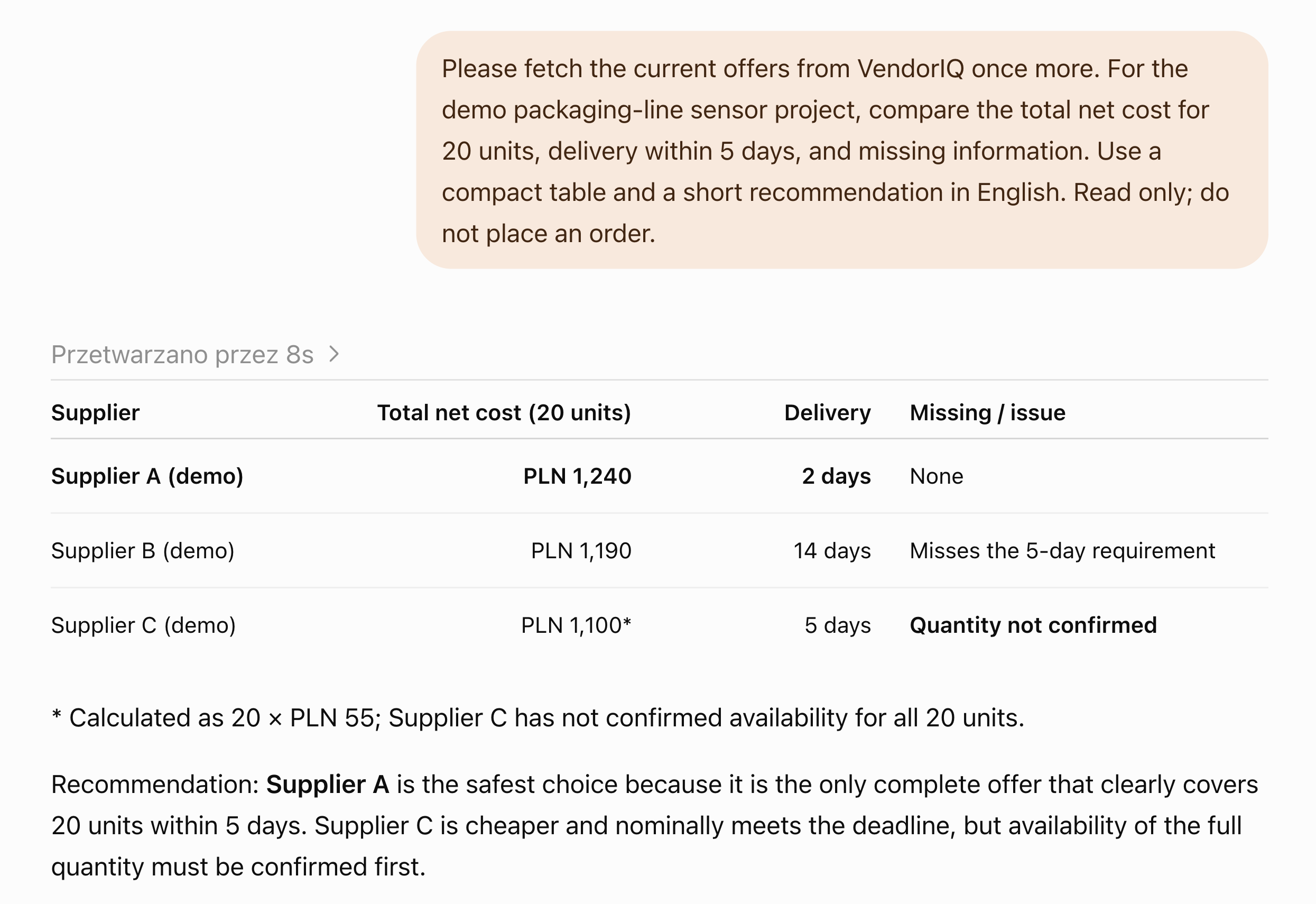
M12 sensor · 20 units · net prices in PLN
Delivery in 2 days for PLN 50 more than quote B. Quote C needs quantity confirmation.
A short introduction and the complete in-app workflow: BOM, suppliers, quotes, recommendation and purchase order approval.
The narration from the VendorIQ video, presented using demonstration data.
VendorIQ is AI-assisted purchasing software for teams buying industrial parts and components. It connects incoming requests, supplier quotations, and purchasing decisions in one workspace, from the first request to a draft purchase order.
Instead of moving between inbox threads and spreadsheets, your team gets a structured project: the requested parts, the supplier conversation, and the next action, together.
The workflow is straightforward. Import a bill of materials. Review the suppliers and approve quotation requests. Compare their replies, inspect the recommendation, and prepare purchase orders.
AI prepares the information. People make the commitments. Your original parts remain unchanged, substitutes require a decision, and orders need approval. Now, let's see the workflow in action.
Purchasing starts with a parts list. Then come the emails, quotations, follow-ups, and decisions. VendorIQ brings that work into one connected workflow, with your team in control.
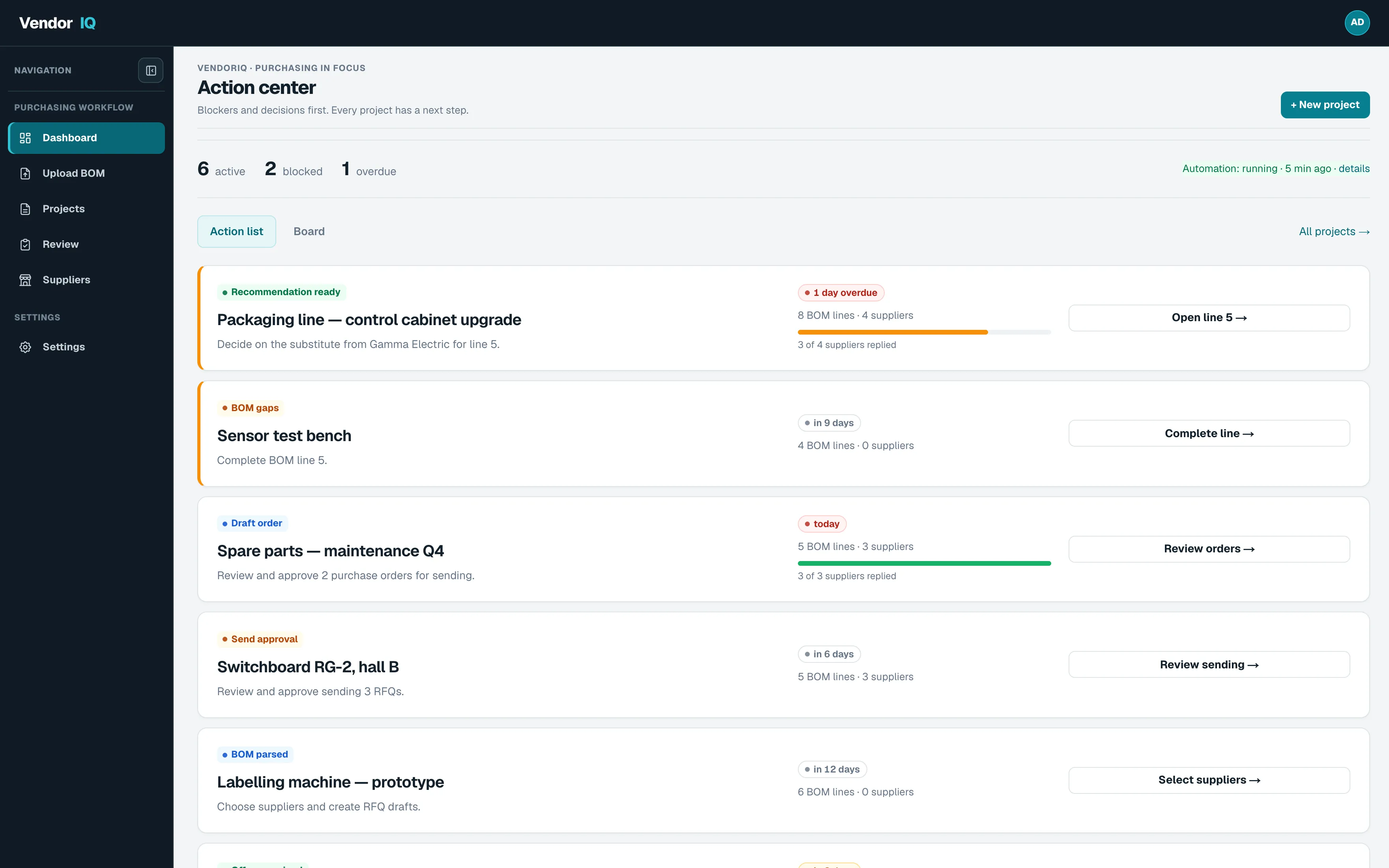
The action center shows what needs attention across your projects: incomplete specifications, requests awaiting approval, incoming offers, and orders ready for review. Every project has a clear next step.
Start with an incoming request and its attached bill of materials, or upload a BOM directly. VendorIQ turns the source information into a structured purchasing project, keeping the original request available.
Manufacturers, part numbers, quantities, and technical requirements stay visible line by line. Missing information is flagged for review. The assistant helps structure the data; it does not silently replace the parts you asked for.
Next, match the parts against your supplier catalog and review the proposed supplier list. Requests are grouped by supplier, so each supplier receives one consolidated quotation request for the relevant items.
Before anything goes out, review the recipients, the email, and the requested parts. Sending requires your approval. Your team controls the supplier conversation, while VendorIQ takes care of preparing the request.
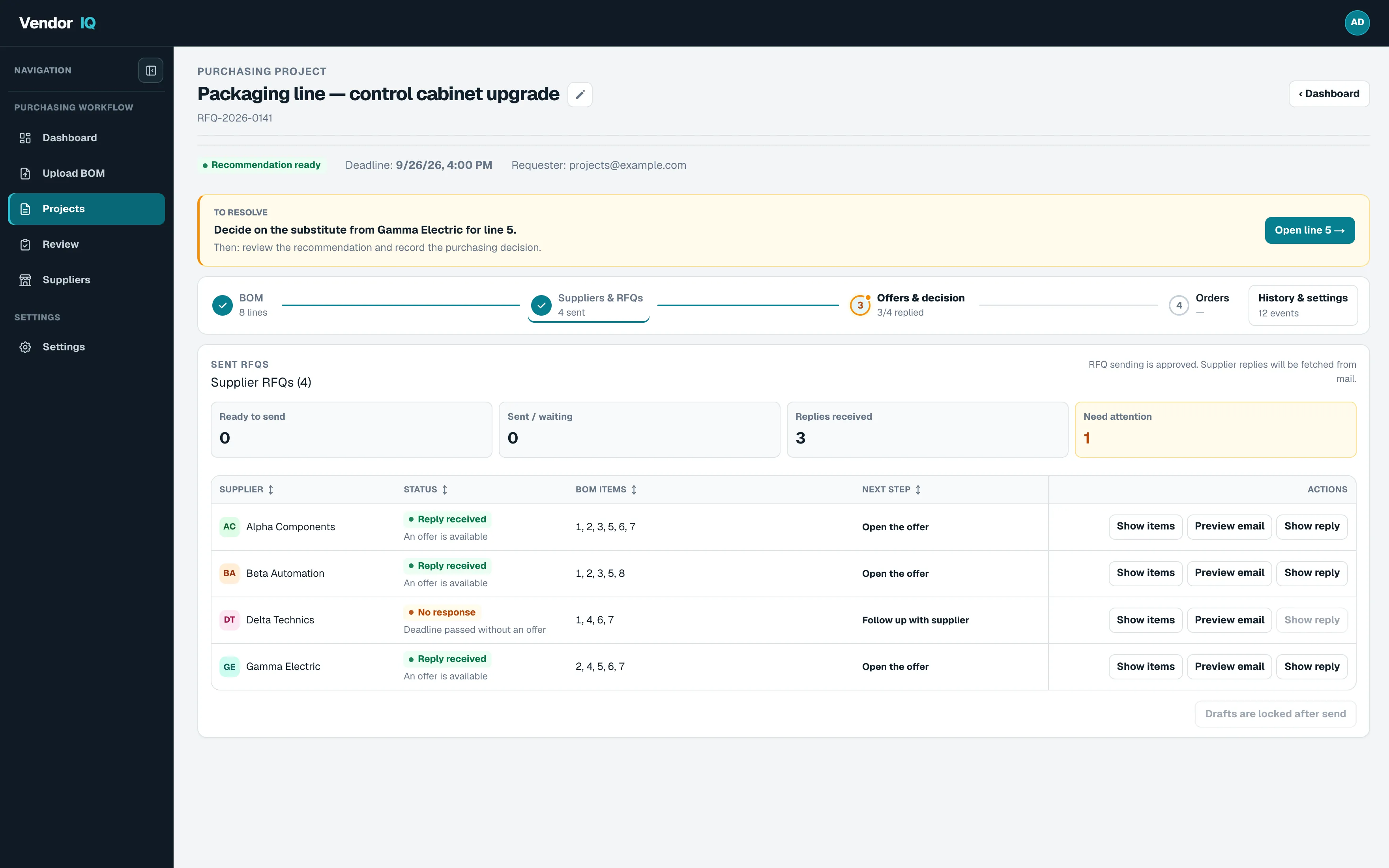
As suppliers reply, their messages remain connected to the project. Offer details are extracted into structured records, with prices, currencies, lead times, and commercial terms. You can still inspect the source email.
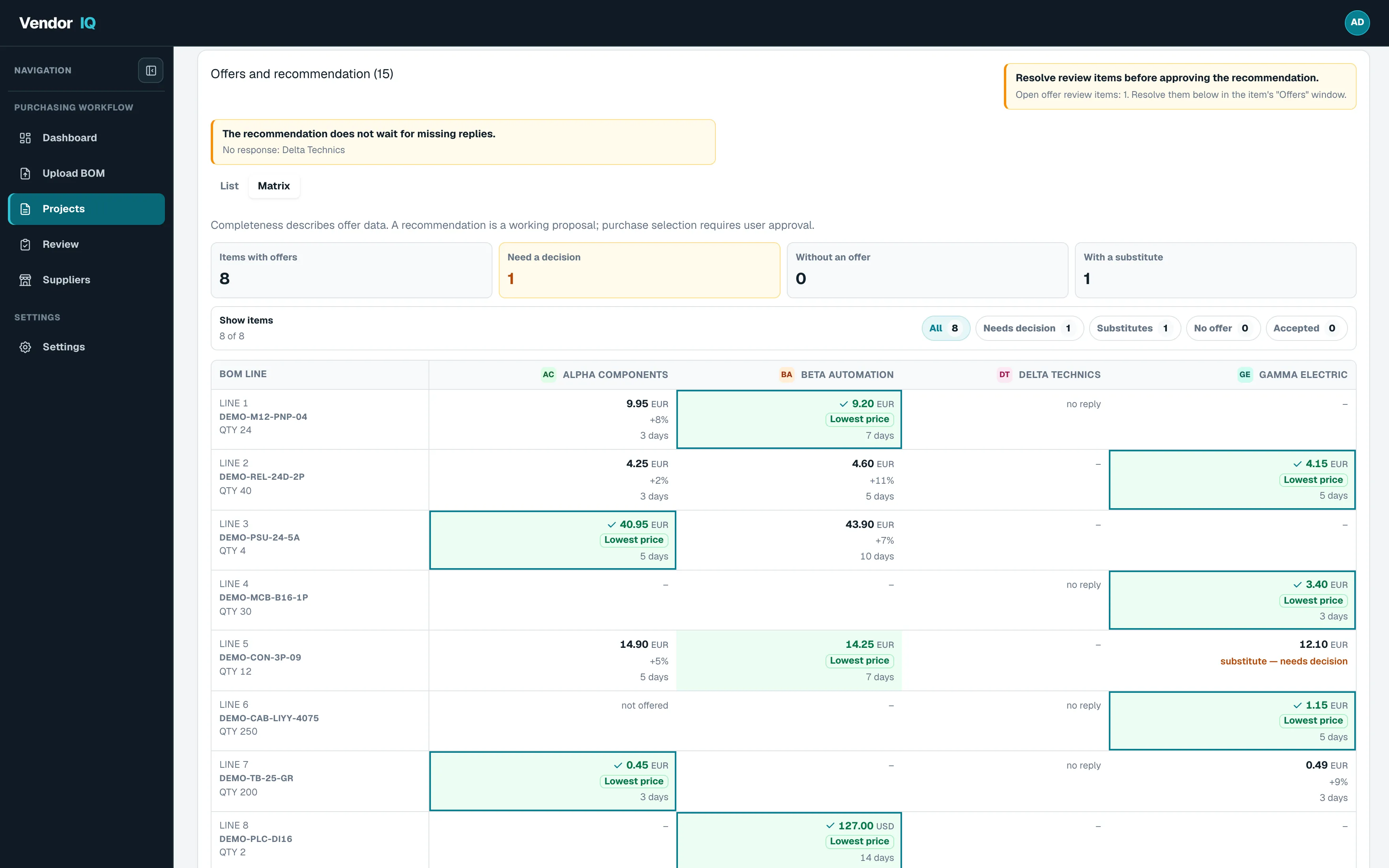
Compare offers side by side, part by part. See who quoted, what is missing, and where price or delivery differs. Incomplete offers and different currencies remain visible, so a low headline price never tells the whole story.
When a supplier proposes a substitute, it is clearly marked for a decision. Your team can inspect the change and accept or reject it explicitly. Uncertain specifications and incomplete offers also have a dedicated review path.
VendorIQ prepares a recommendation from eligible offers, with the reasoning visible for each line. Missing supplier replies do not block the process after the deadline. Review the proposal, then approve your purchasing decision.
The approved selection becomes purchase order drafts, grouped by supplier. Check the quantities, agreed prices, and terms before approval. Preparing an order and authorizing its release are separate steps, keeping the final commitment with your team.
The project history connects the original request, supplier messages, recommendations, approvals, and orders. Your team can follow what happened and why, without reconstructing the purchasing process from scattered inbox threads.
From the first RFQ to the approved order: one connected workflow, clearer decisions, and human control at every important step. That is VendorIQ.
The RFQ starts in an email, the comparison ends up in Excel, and the decision stays in a thread or in the buyer’s head.
VendorIQ extracts the data, suggests suppliers and prepares RFQ drafts. Uncertain information is flagged for review.
The buyer reviews price, delivery, completeness and risk before approving. A purchase order draft follows the decision.
Every project shows one next step: what to do now, where, and what comes after it.
Items from the email and attachments appear in one list. Gaps show up in the BOM right away, and you complete them there.
Use your company database and, optionally, the VendorIQ catalogue. Approve the selection, then the sending of one RFQ per supplier.
Prices, lead times, missing details and substitutes in one comparison, with a recommendation. You also see which suppliers you are still waiting for, and until when.
The purchase order draft is based on the quotes you accept.
Real application screens. Projects, suppliers and amounts are demo data.
Connect VendorIQ to ChatGPT or configure another MCP client. Ask about projects, compare quotes and prepare changes in conversation, using the data you can access.
“Compare quotes for 20 sensors. I need delivery within 5 days. Highlight missing information.”
Projects, BOM, suppliers, quotes, emails, recommendations and decision history. Edit names, notes, RFQ/PO drafts and templates through proposals you approve in VendorIQ.
You approve changes. The assistant does not approve purchases, substitutes or sending, and does not change BOM parts.
Settings → AI assistants / MCP includes guides for 15 apps and clients:
ChatGPT was tested against the test instance. Other guides are based on vendor documentation and require separate verification. n8n, Windsurf / Devin Desktop, Cline, Roo Code and Continue also require verification of OAuth with a pre-registered client ID. Availability depends on the app version and plan.
Select AI assistants / MCP in your instance and copy the server URL.
Follow its guide. Your administrator assigns an OAuth client ID for the app.
Sign in, review access permissions and ask about your projects.
Connections use OAuth and Streamable HTTP. Data used in conversation is shared with your chosen AI provider within the granted access. The server URL alone does not replace OAuth setup.
overviewfind_projectsread_projectfind_suppliersfind_emailsread_emaillist_reviewsdiagnosticsget_project_summaryget_project_bomget_project_offersget_project_suppliersget_project_ordersget_project_reviewsget_project_auditget_project_attachmentsget_project_decisionsget_project_allocationsget_project_recommendationget_supplierget_project_templatesget_action_statuspropose_rename_projectpropose_append_project_notepropose_replace_project_notespropose_edit_rfq_draftpropose_edit_po_draftpropose_edit_project_templatepropose_reset_project_templatepropose_supplier_previewpropose_offer_recommendationpropose_order_draftspropose_supplier_questionspropose_retry_email_analysispropose_actionEach proposal returns an approval link. Preparing it does not execute it.
See what the system prepares, where it highlights missing information and which decisions stay with your team.
Your BOM, company database and the VendorIQ catalogue. Preview suppliers, covered items and missing information before creating drafts.
Explore the workflow from BOM to sendingPrice, quantity, currency, delivery and validity alongside the right BOM item. AI recommendations include a reason, and missing data stays visible.
See a worked comparisonYour company database is the default. Enable the VendorIQ catalogue for each project when needed. Only records ready for use are included in matching. Enabling the catalogue does not send any emails.
A good fit for BOMs, short production runs, maintenance and projects with several suppliers.
Source project components when price, lead time and possible substitutes matter.
Compare devices, enclosures and accessories without manually piecing together multiple emails.
Purchase for projects and short runs when every parts list needs several sources of supply.
Check spare-part availability sooner, before a missing delivery holds up a repair.
It starts with everyday component purchasing: different quote formats, incomplete replies and delivery dates to compare before ordering.
VendorIQ is developed by PWM Automatyka sp. z o.o., an industrial automation company. It grew out of our own challenge: getting from a parts list to a purchasing decision faster.
Pricing and infrastructure requirements are agreed individually.
Compare the number of quotes you receive today with your target. Estimate the price difference for the purchases you want to compare.
VendorIQ keeps data, decisions and sent messages in one history. You can return to the information behind each decision.
Example workflow history
VendorIQ is developed by PWM Automatyka sp. z o.o. Company details and contact information are available in the Trust section and in the footer.
VendorIQ is a request for quotation (RFQ) workflow system for purchasing and procurement teams buying technical components. It connects the bill of materials (BOM), supplier RFQs, quote comparison and purchase order drafts. AI helps extract and compare data; the user approves sending, substitutes and purchasing decisions.
The system takes over repetitive work: reading emails and attachments, matching suppliers, drafting RFQs, analyzing replies, preparing recommendations and creating purchase order drafts for approval.
No. VendorIQ prepares a recommendation, but the purchasing decision, substitute approval and final order submission remain with the user.
Every project shows one next step: what to do, where, and what comes after it. If something blocks the process — a missing BOM line, a substitute to decide on or a failed send — a button takes you straight to where you resolve it. The dashboard collects these steps across projects: blockers first, then actions, then projects waiting for supplier replies.
During the demo stage we discuss a pilot and an individual quote. Scope depends on RFQ volume, email integration, supplier data and the level of technical support required.
Infrastructure, email, AI model and data-access requirements are agreed before the pilot. An on-premise deployment and integrations require a separate scope and quote.
For companies that regularly collect quotes from multiple suppliers: technical parts, production components, maintenance, repair and operational purchasing.
Your company supplier database is the starting point. You can also enable the VendorIQ catalogue for a project. Only records ready for use are included in matching; a catalogue entry does not guarantee product availability. You approve recipients and sending separately.
You can provide a bill of materials (BOM) in an email or upload a file, including PDF, Excel (XLSX, XLSM, XLS), CSV, EML, TXT and Word (DOCX, DOC). Review the extracted data; unreadable or missing information needs user input. The system should not invent part numbers or quantities.
VendorIQ receives messages through IMAP and sends approved messages through SMTP. It can also save messages as drafts in an IMAP mailbox. Support for a particular mailbox, authentication and permissions are agreed before the pilot.
After the reply deadline, missing quotes do not block a recommendation based on available replies. Missing replies and incomplete quotes remain visible. The user makes the purchasing decision using confirmed terms.
Industrial automation, electrical panels, MEP/HVAC construction, machine building, automotive, electronics/EMS and maintenance teams. In construction the file may be called a BOQ, takeoff or MTO, but the purchasing challenge is the same.
Show us how you collect quotes. Together, we can identify what to automate and how to evaluate a pilot.